Finnegan’s fall and wake
Finnegans WakeFinnegan’s fall and wake turns the collapse of a builder into a communal rite whose grief cannot be separated from festivity and whose ending cannot settle whether death is final. Bygmester Finnegan rises from the work of building toward a sky-high monument, then falls; the wake gathers a nation around his bier, but the text leaves his body at once dead, dispersed, and recoverable in the image of a giant still asleep. The episode establishes the book’s central instability: a fall can be an ending, a public story, and the beginning of another cycle.
Identity and Background
Bygmester Finnegan is introduced as a man of hod, cement, and edifices, a builder living in an expansive, barely bounded landscape before judges have assigned numbers to dwellings. The account makes his identity inseparable from labor and construction: he piles building upon building on riverbanks, wielding a trowel in ivoroiled overalls. His stature is described not through a settled biography but through the scale of his work and the extravagant verbal architecture that surrounds him.
His building grows into a sky-reaching structure, a waalworth of a skyscape that rises from next to nothing toward the heavens. The scene’s ascending motion gives the later fall its force: the man who has raised himself and his work to monumental height is made vulnerable to a descent. A burning bush crowns the structure, while workers and buckets move up and down its sides, making construction itself a spectacle of vertical movement before the fall reverses that movement.
The narrative also surrounds the builder with names and identities that shift rather than stabilize. He is associated with Wassaily Booslaeugh of Riesengeborg, and the heraldic description of a green field, a he-goat, and armed archers gives him the outlines of a public or legendary figure. The wordplay around Mister Finn, Mister Finnagain, Mister Funn, and being fined again makes identity sound cyclical: the name returns altered, and the prospect of a new beginning carries the echo of punishment.
Causes and Uncertainty of the Fall
The fall is announced as an immense, world-shaking event, but its cause is not resolved. The account calls it the fall of an old wall and connects it to Finnegan’s abrupt pftjschute; elsewhere, it asks what brought about the “tragoady thundersday” and offers competing explanations. It may have been a misfired brick, or the collapse of his back promises. The possibilities remain alternatives in a field of stories, not a definitive finding.
That uncertainty is part of the event’s public life. The text says that a thousand and one stories have already grown around the same occurrence. His cubehouse still rocks as an earwitness to thunder, while successive ages pass on a chorus of accusation and rumor. The fall therefore has two linked forms: a physical collapse registered in the shaking structure, and a social afterlife in which the cause is retold, embellished, and contested.
The commotion surrounding him is rendered as a citywide uproar of vehicles, trades, institutions, and spectators. The crowded catalogue makes the event larger than an isolated accident, as if the town’s whole machinery of streets and public life had gathered around the builder’s fate. Yet the narrative does not turn this scale into certainty. Among the noise, it leaves open whether the decisive cause was a brick, a broken promise, or another version among the many circulating accounts.
The Fall and Its Immediate Consequences
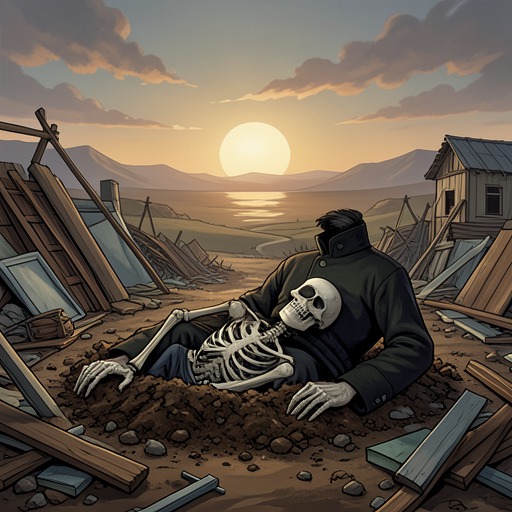
At the decisive moment, Finnegan is warned and is already heavy with drink: his head feels heavy and his hod shakes. A wall is in erection; then the sound of impact breaks the scene into abrupt beats. He staggers from the ladder and is declared dead. The sequence moves from construction to instability to a fall, while the terse rhythm of the repeated impact words gives the collapse a blunt finality that the surrounding verbal profusion cannot soften.
The event is also described as a descent that sends an “unquiring one” westward in search of Finnegan’s toes, which have been turned upward in the park. That image converts the fall into a dislocated, almost landscape-sized body: the fallen man is not simply at rest in one place but becomes the object of a search. The oranges laid to rust upon the green supply a precise ground for this aftermath, binding the mythic scale of the collapse to a particular park scene.
The apparent death does not close the episode. The text’s opening description places the fall early in the story and says it is retold through Christian minstrelsy and down through life. It thereby presents the incident not as a single, securely contained past event but as a story repeatedly carried into later time. Retelling preserves the catastrophe while changing its scale and circumstances, allowing the fall to function as both an occurrence and an inherited narrative.
The Wake: Mourning and Feast
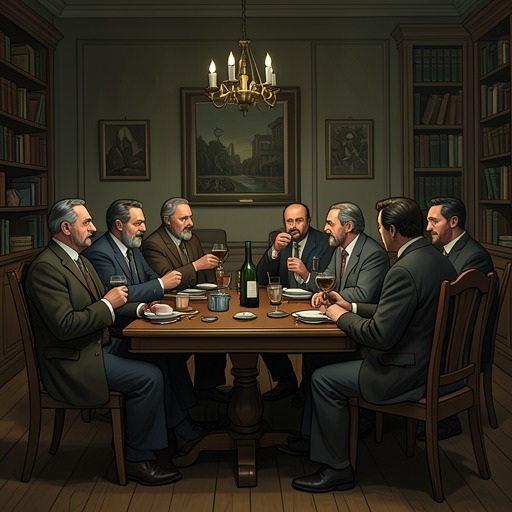
The wake begins in lament. The mourners ask why Finnegan has died on a trying Thursday morning, and the nation gathers in consternation, producing an enormous chorus of sighs and cries. People keene, bell him up, and fill him down; the language makes mourning a collective physical action, not merely a private response. Finnegan is laid along his last bed, with pillows sharpened and his bier prepared, as the assembly turns his death into a public ceremony.
Yet grief continually changes its charge. The mourners’ ululation is described as profuse, but they join in with the greatest conviviality, and the wake continues as a celebration. The assembly is at once prostrate and noisy, sorrowing and socially animated. Its emotional contradictions are not resolved into a single proper response: lament gives way to festivity without displacing the knowledge that the man at the center of the gathering has been declared dead.
Food and drink make that contradiction tangible. A loaf of bread is placed at Finnegan’s head, while a glass of Dublin ale is hitched to the hop in his tail. The wake’s feast turns the body into the center of an offering and a drinking ritual, but the promised act of eating and drinking falters: the body is a flower-white behemoth and then is nowhere. The meal is dead off for someone, and the wake’s conviviality meets the disappearance of the person it was meant to honor.
Disappearance, Sleep, and Recurrence
After the feast, Finnegan becomes a fadograph of a yesterday’s scene, an image from the past rather than a body that can be held present. He is described as smolten in mist, packed away, and gone from the meal. These transformations do not simply cancel the earlier declaration of death; they make the status of the dead man difficult to fix. The wake’s evidence is material and ceremonial, but its central figure slips from view.
The text nevertheless offers a counter-image: a brontoichthyan form remains outlined as if asleep by a troutling stream. The giant’s clay feet stick up where he last fell, near the Magazine Wall, while a nearby woman sees all. The scene retains the bodily fact of the fall but recasts the body as a sleeping, monumental presence. Death and sleep overlap, so that the figure who has vanished from the feast can still be imagined as lying in the landscape.
This movement from collapse to wake, disappearance, and sleep gives the event its cyclical structure. Finnegan’s name itself returns through altered forms, and the account of his fall is repeatedly handed down; the wake likewise makes an apparent ending into a scene of continuation. The episode does not confirm a literal resurrection. Instead, it holds death beside survival in memory, rumor, and the image of the sleeping giant, leaving recurrence as a possibility built into the story’s form.